Uncovering a new AGN evolutionary pathway at Cosmic Noon with JWST


Using JWST Near-infrared Camera (NIRCam) imaging, I conducted a two-part investigation (Bonaventura et al. 2025, 2026) into how active galactic nuclei (AGN) are connected to the structural evolution of their host galaxies during the peak epoch of galaxy growth (0.6 < z < 3.8). I began by exploiting NIRCam's unprecedented spatial resolution and sensitivity to perform a pixel-level, non-parametric morphological analysis of one of the most complete multi-wavelength AGN samples assembled to date, including heavily obscured and Compton-thick systems previously inaccessible to optical or X-ray-only studies. By combining visual classification with quantitative computer-vision metrics that measure spatial asymmetry and disturbance, I demonstrated a statistically significant link between galaxy mergers and nuclear obscuration, showing that the vast majority of obscured, Seyfert-luminosity AGN reside in strongly disturbed host galaxies. This result directly challenges long-standing models in which moderate-luminosity AGN are fueled primarily by secular, non-merger processes.
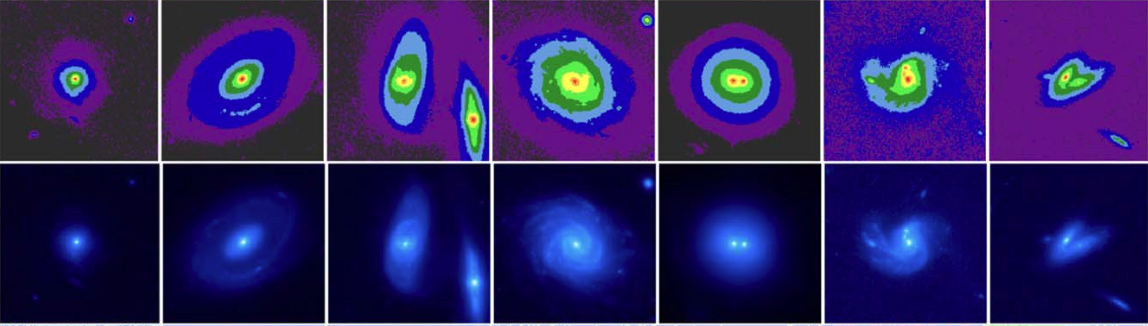
Building on this discovery, I expanded the analysis to a multi-metric image-analysis framework and introduced carefully matched inactive control galaxies to isolate the physical drivers of the observed disturbances. This broader approach revealed that X-ray- and mid-infrared-selected AGN are not likely to be distinct populations, but instead represent different evolutionary phases along a common, merger-driven timeline. Together, these results establish mergers as a key mechanism in triggering obscured AGN growth at Cosmic Noon.
Learning the physics of galaxies through signal processing, remote sensing, and satellite image analysis
Thus far in my astrophysics research career, I have focused primarily on photometric and spatial morphological analyses of distant galaxies in infrared imagery obtained with space-based telescopes, including the NASA Spitzer and Webb space telescopes, as well as the ESA Herschel space observatory. Working at the intersection of image science and computer vision, I utilize pixel-level analysis techniques to extract physically meaningful quantities that lead to publications of observational galaxy science in top astrophysical journals.


Credit: Hostinger
Investigating the curious extended spatial morphologies of Little Red Dots with JWST
In a collaborative study investigating the nature of "Little Red Dots" (LRDs), a newly identified population of compact galaxies revealed by ultra-deep JWST/NIRCam imaging, I contributed a non-parametric morphology analysis of a sample of 99 LRDs uncovered by the JWST Advanced Deep Extragalactic Survey (JADES). This analysis tested whether these systems are truly compact or instead hide unresolved structural complexity. The work was motivated by the observation that LRDs appear deceptively simple in rest-frame optical light, yet pose a major challenge to galaxy-evolution theory because many host apparently over-massive, rapidly growing black holes at very early cosmic times.


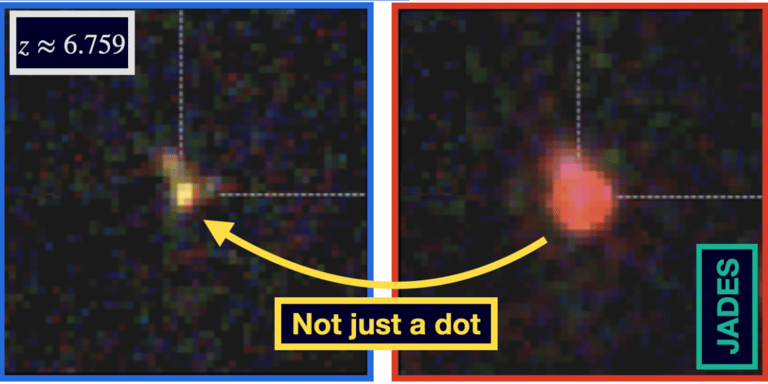
Credit: P. Rinaldi, JADES, NASA
By exploiting the wavelength-dependent resolution of JWST, this spatial morphology analysis revealed that a significant fraction of LRDs exhibit clumpy, asymmetric, and disturbed morphologies in the restframe ultraviolet, despite appearing smooth and point-like at longer wavelengths. This provided strong evidence that interactions, mergers, and irregular star-forming structures are common within the LRD population, supporting a physical picture in which galaxy interactions help trigger rapid black-hole growth during the earliest phases of galaxy assembly.
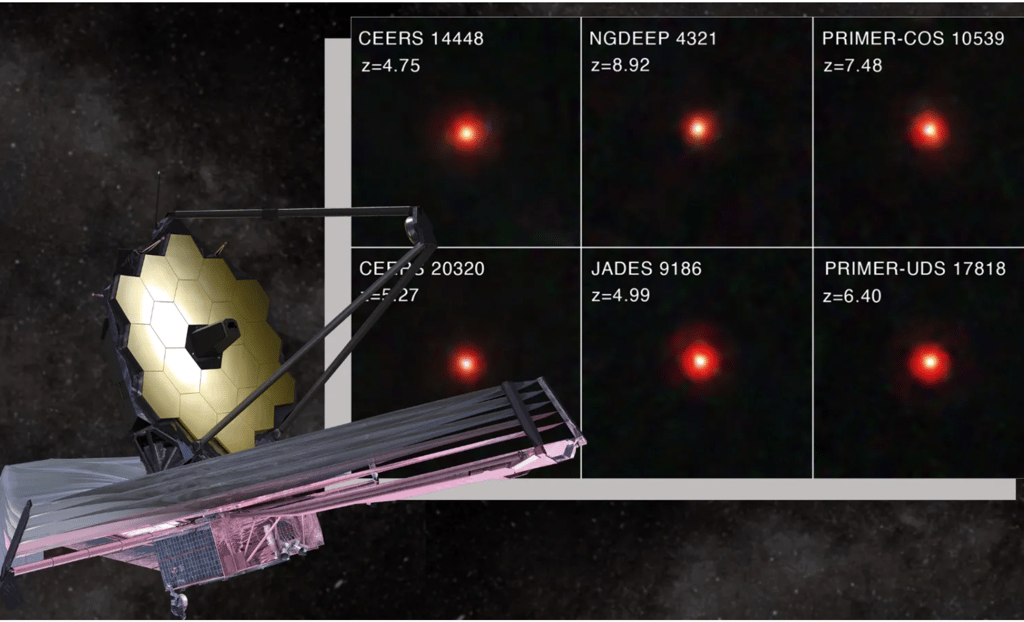
Image credit: NASA, ESA, CSA, STScI, Dale Kocevski (Colby College)/ Robert Lea
A multiwavelength exploration of unexpected star formation activity in Brightest Cluster Galaxies
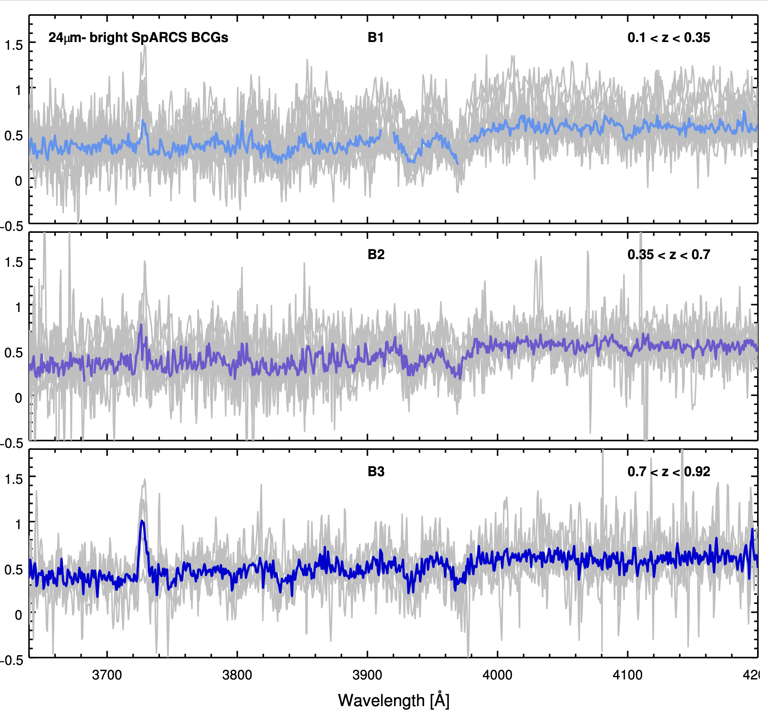
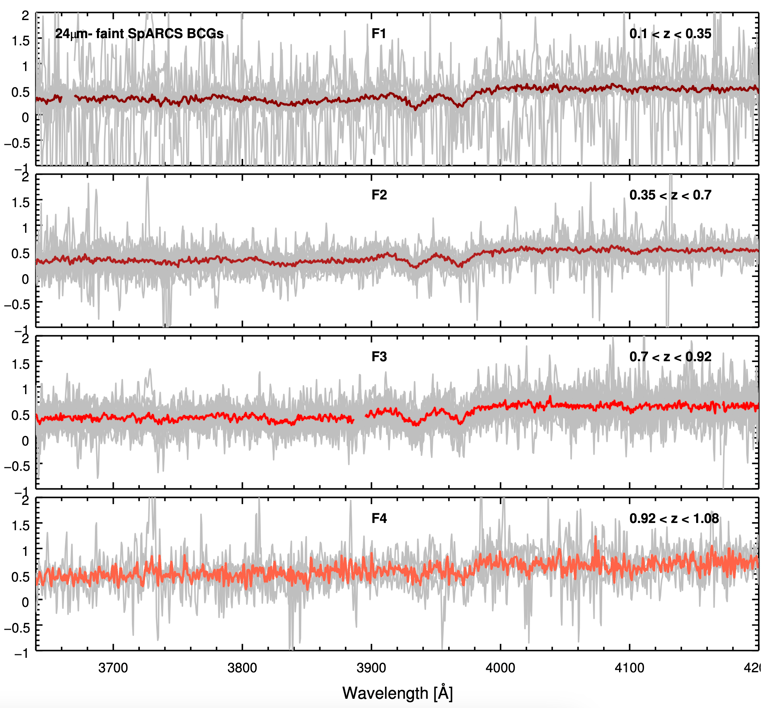
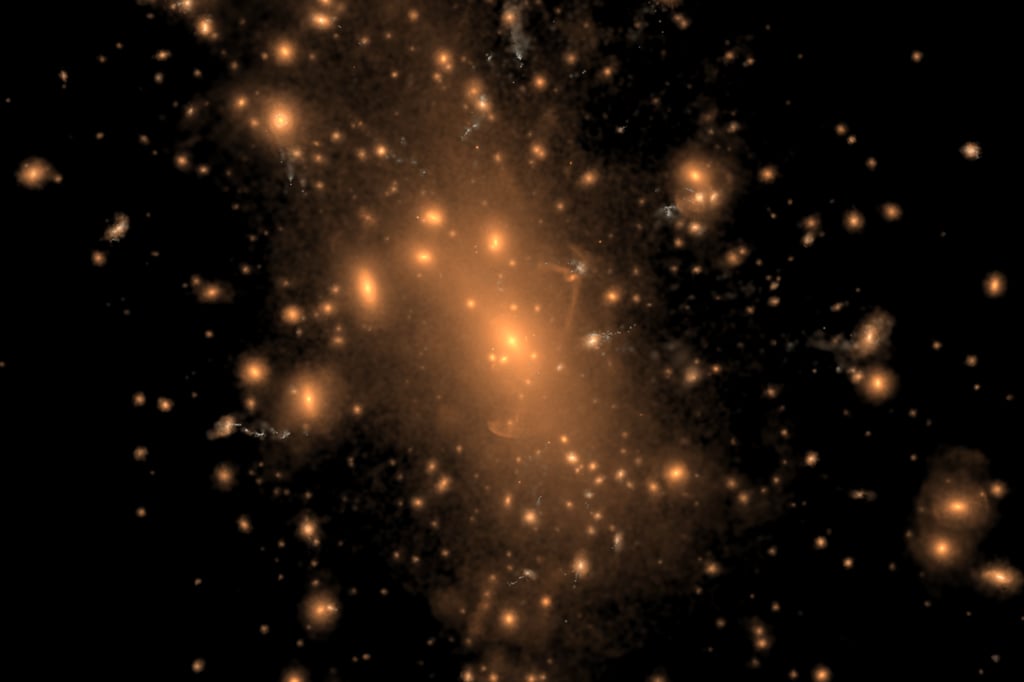
For my Physics Ph. D. thesis (Bonaventura 2017), I conducted an unprecedented study of the far-infrared Spectral Energy Distributions (SEDs) and optical spectra of the largest sample of Brightest Cluster Galaxies (BCGs) known at the time of writing, those detected by the Spitzer Adaptation of the Red-sequence Cluster Survey (SpARCS). Given the tension that existed between model predictions and historic observations of BCGs at z < 2, the aim was to uncover the dominant physical mechanism(s) guiding the stellar mass buildup of this special class of galaxies, the most massive in the Universe, uniquely residing at the centers of galaxy clusters.
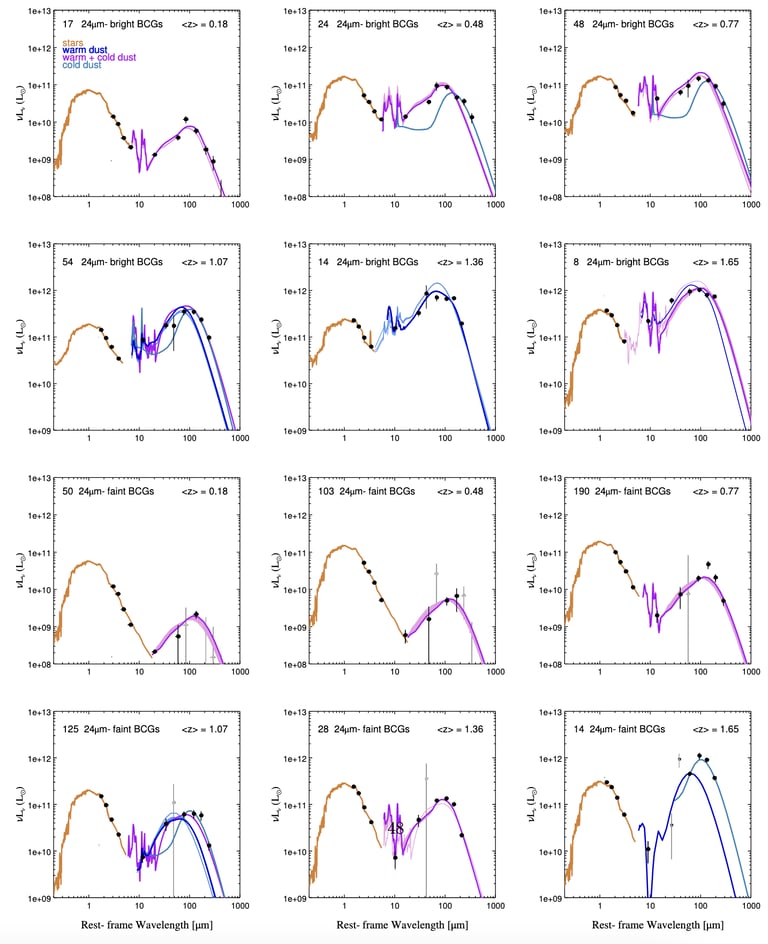
This photometric and spectroscopic campaign revealed that BCGs at z < 2, previously believed to be inactive elliptical galaxies largely devoid of the material to form stars, are significantly star-forming, as confirmed by spectral template model fits to their median stacked Spitzer and Herschel infrared SEDs, using a combination of stellar, cold and warm dust model components. This finding was bolstered by direct detection of emission-line signatures of ionized gas in their optical spectra, and the stellar absorption features and Dn4000 indexes characteristic of a younger stellar population than anticipated for these supposed 'red and dead' galaxies.
This discovery challenged the historically accepted belief that BCGs should only passively evolve through a series of gas-poor, minor mergers since z ∼ 4, but agreed with a current, improved semi-analytic model of hierarchical structure formation that actually predicted star-forming BCGs throughout the epoch considered. This unexpected star formation activity is likely caused by major and/or minor `wet’ (gas-rich) mergers, based on a lack of key signatures of cooling-flow-induced star formation, as well as a number of observational and simulation-based studies that support this scenario.
Figures 3-2 and 3-3 of Bonaventura (2017) showing the median-stacked, de-redshifted optical spectra of mid-infrared-bright (blue) and faint (red) BCGs, exhibiting spectral features consistent with both instantaneous and recent star formation, as well as a relatively young stellar population.
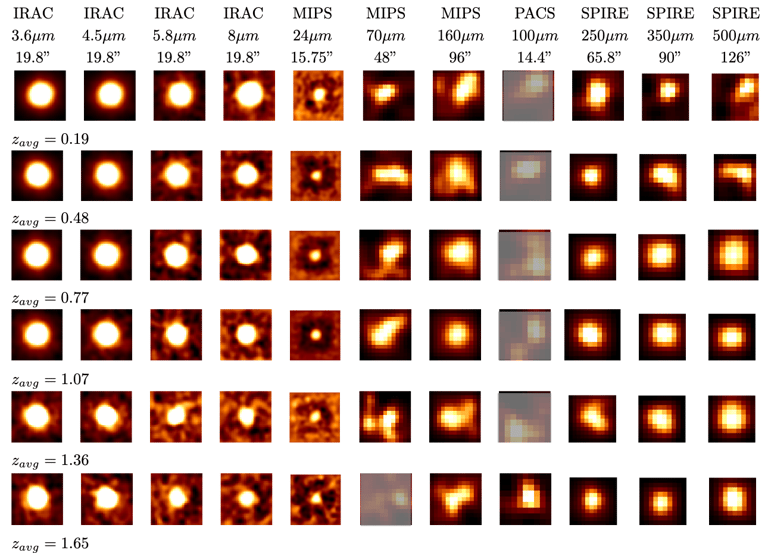
Figure 2 of Bonaventura (2017) showing calibrated, corrected, background-subtracted Spitzer and Herschel images of BCG infrared flux stacked in multiple redshift and wavelength bins, used to generate SEDs of PSF-matched, median stacked luminosity values. Grayed-out images mark those with a low signal-to-noise ratio.
Figure 6 of Bonaventura (2017) showing the stacked Spitzer and Herschel median infrared luminosity SEDs, unexpectedly well-fit by a star-forming as opposed to quiescent elliptical model, comprised of a stellar and dust component.
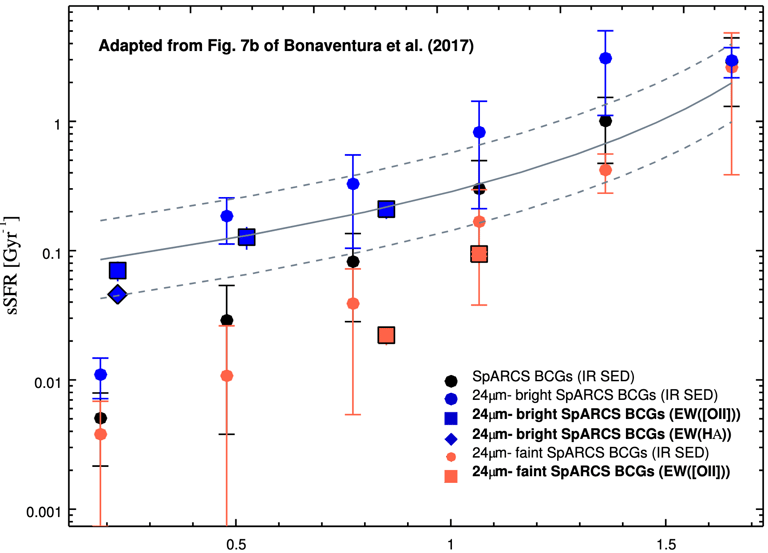
Figures 3-11 of Bonaventura (2017) displaying a comparison between the SpARCS BCG specific star formation rates estimated from the H-alpha and [OII] emission features detected in the median-stacked optical spectra, and those independently derived from the median-stacked, broadband infrared SEDs, as a function of average bin redshift. The solid line represents Equation 13 of Elbaz et al. (2011) and traces the position of main-sequence galaxies. The dashed curves lie a factor of two above and below the solid line, bounding the region of main-sequence galaxies, with quiescent and low-star-forming galaxies lying below and starburst galaxies lying above at all redshifts.