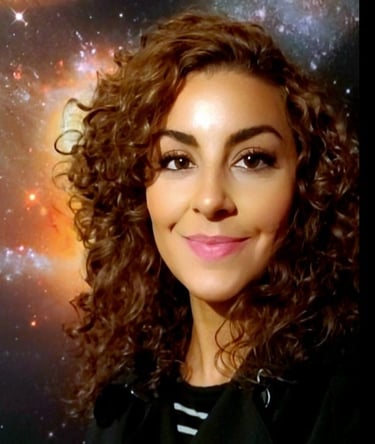
Nina Bonaventura, Ph. D.
Processing signals from space for scientific discovery and prediction through image analysis, physics, and space-based observing.
Experience
I am an observational physicist and image scientist with extensive experience supporting NASA space missions and conducting astrophysics research with space-based optical, infrared, and X-ray sensing systems. My work spans scientific image and spectral analysis, astronomical instrumentation, algorithm development, scientific software, observation-system optimization, and instrument commissioning.
I have contributed to two flagship NASA observatories, the Chandra X-ray Observatory and the James Webb Space Telescope (JWST). My work has included developing and deploying scientific analysis software for the Chandra user community; developing novel algorithms for complex JWST/NIRSpec observing programs; supporting NIRSpec commissioning from the JWST Mission Operations Center; and leading pixel-level JWST/NIRCam imaging studies using techniques including object detection and classification, image segmentation and filtering, feature extraction, and statistical characterization.
More recently, I have expanded this foundation into scientific machine learning and systems-level technical leadership. I have developed physics-informed PyTorch models using Solar Dynamics Observatory imagery and uncertainty-quantification methods, and I currently lead the technical delivery and integration of multidisciplinary, AI-enabled space-science capabilities for NASA partners. Across research, instrument science, scientific software, and technical program leadership, my work has consistently connected physics, space-based observations, scientific imaging, algorithms, and multidisciplinary technical teams.
Roles
US Program Manager - Frontier Development Lab (FDL) Heliolab
Led a JWST/NIRCam research program analyzing imagery of more than 400 galaxies through pixel-level image processing, object detection and classification, segmentation, filtering, feature extraction, and statistical characterization. Led optimization and calibration work involving JWST/NIRSpec spectroscopy and developed algorithms and software for complex space-based observing programs.
JWST/NIRSpec Instrument Expert & Postdoctoral Researcher
Niels Bohr Institute / Cosmic Dawn Center | 2017-2022
University of Arizona | 2022-2025
Research Scientist - Steward Observatory
Machine Learning Researcher - FDL Heliolab
Trillium Technologies | 2026-Present
NASA / Google Cloud / NVIDIA research program | 2025
Developed a physics-informed PyTorch model that inferred parameters governing solar differential rotation and meridional flow from multiple forms of Solar Dynamics Observatory imagery, and applied uncertainty-quantification methods to characterize model confidence.
Lead the operational and technical delivery of a NASA-partnered space-science program applying AI and scientific machine learning to heliophysics and space-weather capabilities. Coordinate multidisciplinary teams of scientists, ML researchers, software engineers, and domain experts across scientific requirements, model development, systems integration, validation, technical review, and operational demonstration.
Developed a novel analytical algorithm for optimizing NIRSpec multi-object spectroscopy, subsequently adopted for ESA-supported commissioning and released for the JWST community. Supported NASA/ESA commissioning, developed instrument-performance analysis procedures, and served as a trained Quick Look Analyst at the JWST Mission Operations Center.
X-ray Data Specialist
Chandra X-ray Center, Smithsonian Astrophysical Observatory | 2007-2012
Developed, tested, and deployed scientific analysis capabilities within NASA's Chandra Interactive Analysis of Observations software, supporting imaging, spectroscopy, and time-series analysis. Led scientific documentation for the Chandra Source Catalog, Sherpa spectral-fitting environment, and Virtual Astronomical Observatory tools.
Education
Ph. D., Physics McGill University
M.A., Astronomy Boston University
B.A., Physics University of Pennsylvania
Astrophysicist & Image Scientist
Dark Machines Research Collaboration | 2020-2022
Led the image-analysis component of a multidisciplinary study using a convolutional neural network trained on simulated astronomical imagery to infer dark-matter mass and spatial distribution.
Contact Me
Reach out via LinkedIn to discuss collaborations and opportunities.
Currently based in Phoenix, Arizona.