Heliolab 2025 Team ARCADE
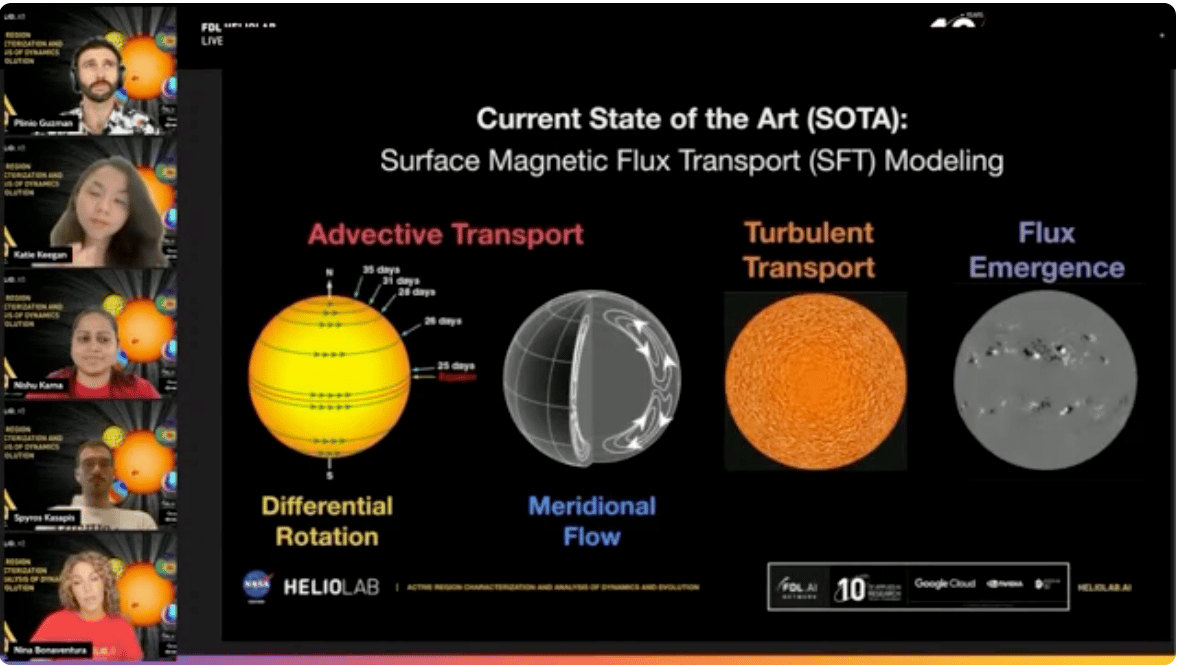
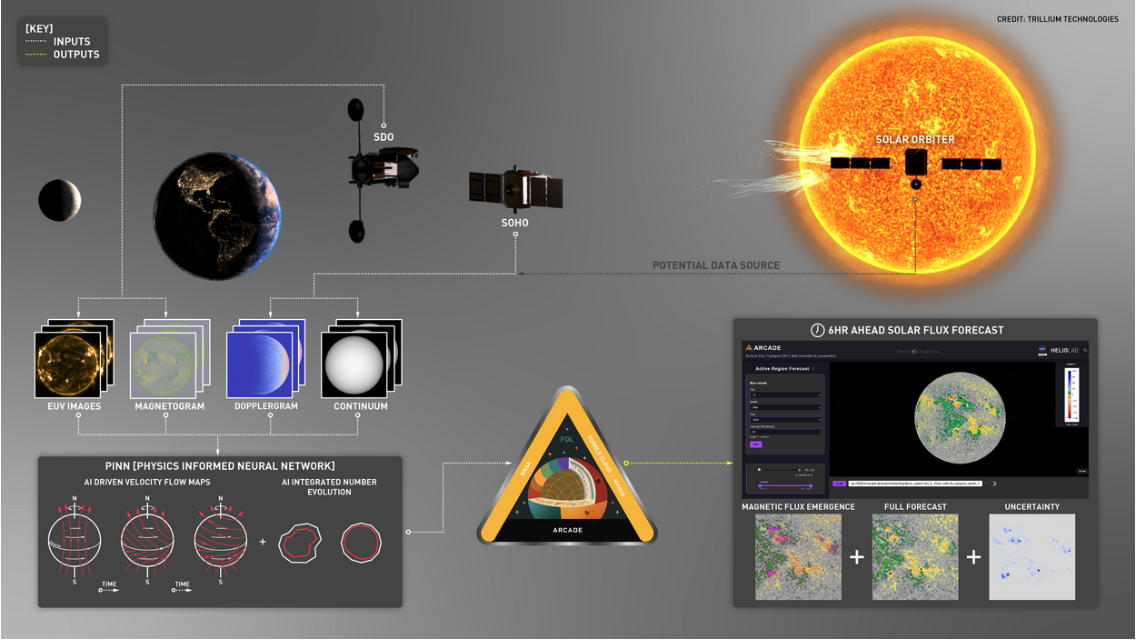
Throughout the summer of 2025, I worked intensively in an "AI bootcamp for space geniuses" helping develop a novel, physics-informed 'gray box' machine learning (ML) model that pushes the frontier of artificial intelligence (AI) in space weather forecasting, supported by NASA, Google Cloud, and Nvidia. Personal contributions include the development of a PyTorch machine learning program that learns the parameters of the physical processes of solar surface differential rotation and meridional flow, from five different types of input solar imaging observations obtained with the Solar Dynamics Observatory, using Last-Layer Laplace Approximation for uncertainty quantification.
Frontier Development Lab (fdl.ai)
Heliolab 2025 Team ARCADE Live Youtube Showcase
Forecasting Space Weather at its Source:
A Gray-Box AI for Solar Active Regions
Read here a blog post I wrote for Trillium Technologies summarizing my team's contribution to FDL Heliolab 2025, and watch a video, linked below, to hear our team present at a live Youtube technical showcase in October 2025.
Determining the Dark Matter Distribution in
Simulated Galaxies with Deep Learning
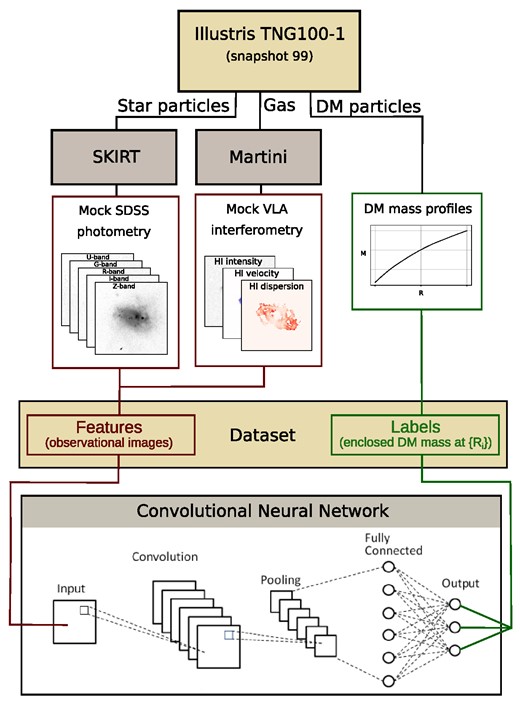
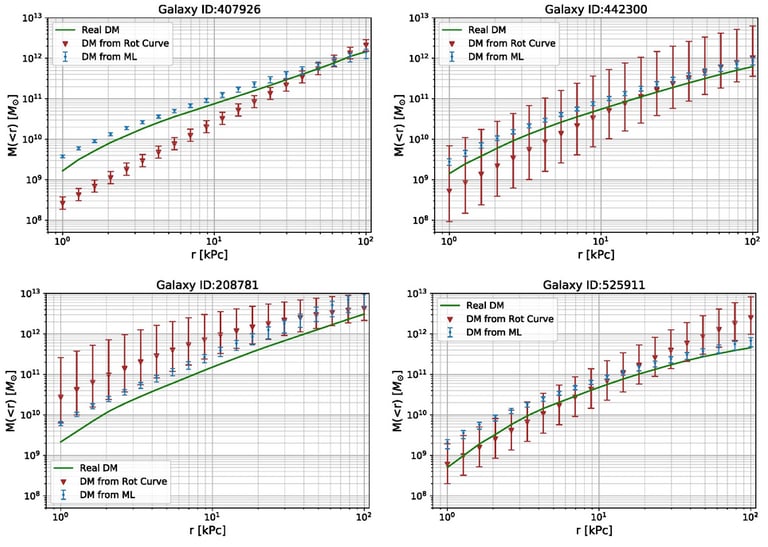
For my 'pandemic project', I worked with a research collaboration of non-astronomer physicists and data scientists, Dark Machines, to lead the astronomical image analysis and galaxy science components of an ambitious study centered on a novel application of Convolutional Neural Networks (CNNs) to photometric galaxy images and neutral hydrogen gas intensity and velocity maps, to predict the dark matter (DM) mass and distribution in galaxies, for the first time (de los Rios et al. 2023). This involved the simulation of optical (stellar-light) galaxy emission in images as it would be observed by the Sloan Digital Sky Survey (SDSS), starting with the idealized form output by the radiative transport code SKIRT, then utilizing Python Astropy via the PTS library to add instrumental effects. The resulting suite of mock photometric images in the five SDSS ugriz bands served as input to our machine learning model that helped train it to output accurate galaxy DM profiles; and represented half of the 'mock Universe' from which physical galaxy parameters were measured in order to constrain DM mass estimates.
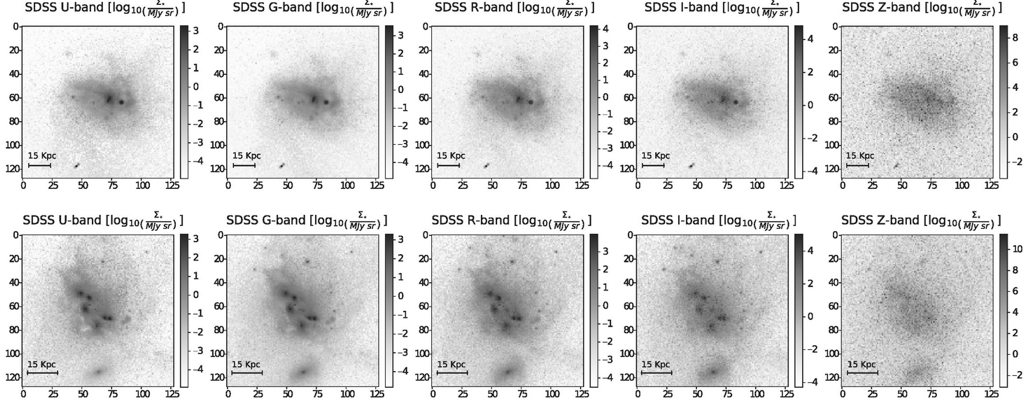
Figure 1 of de los Rios et al. (2023) showing examples of mock photometric SDSS images created as input to the CNN model.
Figure 3 from de los Rios et al. (2023) showing the analysis pipeline used in our work.
Figure 9 of de los Rios et al. (2023) comparing the simulated `real’ DM distribution with the method of rotation curve fitting (brown triangles) and the ML method we employ here (blue dots), highlighting the success of our approach in reliably and accurately estimating the DM mass in galaxies.